The Small Step From Medium to High
How AI reasoning effort changes the search, the wait, and the work left for you.
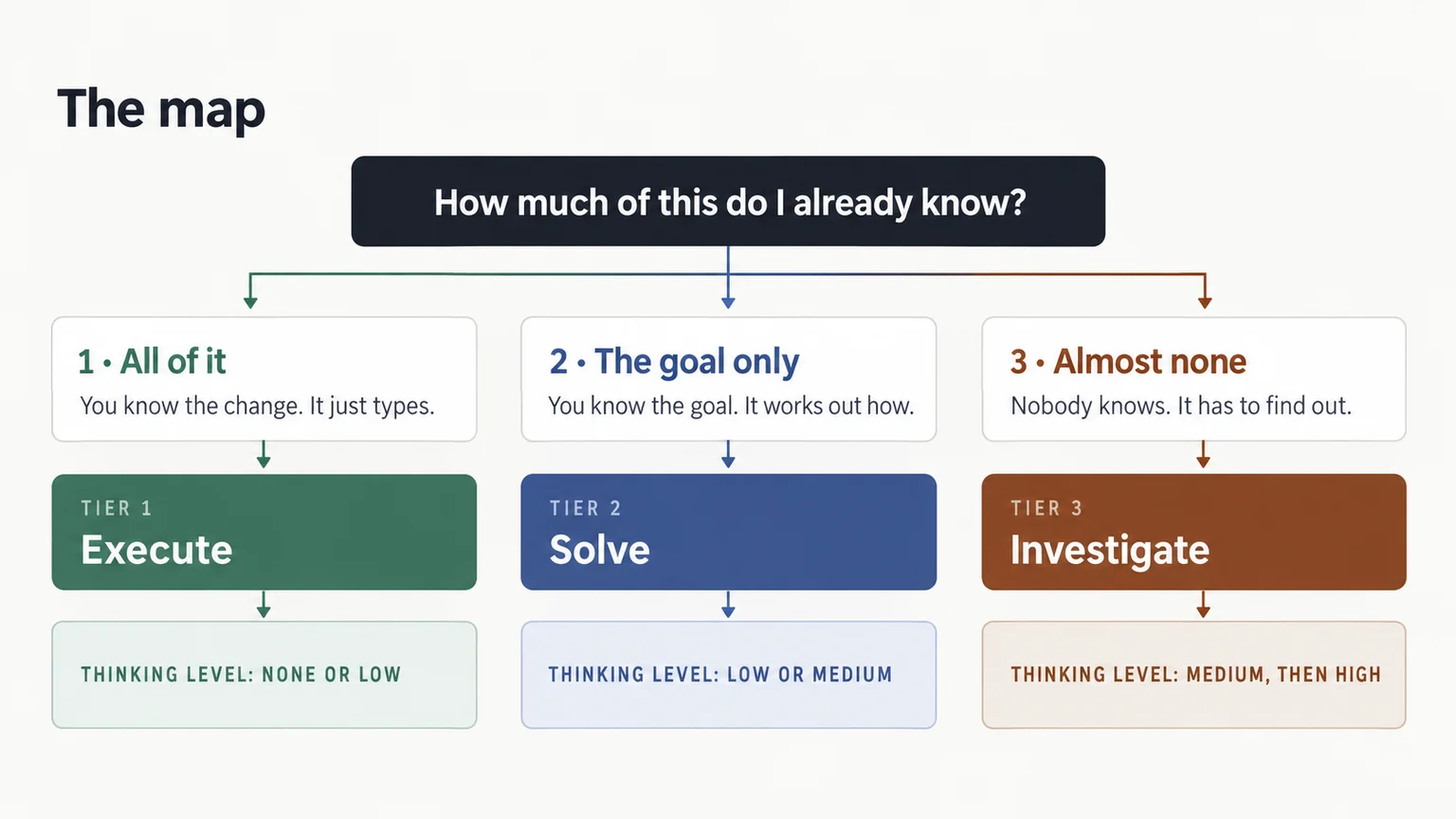
Picture two runs of the same bug fix. This is a thought experiment, not a report from a real project.
The room is quiet. Your tea is cold. A job fails when it gets retried, and you want to know why.
You give the model the logs, the code, and the same brief in two fresh runs. One uses medium reasoning. The other uses high.
The menu makes that look like a small choice.
Same model. Same task. One more notch.
It is easy to expect the same answer, only slower and better checked.
But the difference may show up before there is an answer at all. It may show up in which files the model reads, which paths it tests, and how long it keeps looking before it settles on a fix.
You did not just choose how long to wait.
You changed how much work the model is encouraged to do along the way.
The same task can take a different path
Here is one possible outcome in that imagined test.
At medium, the model finds a missing check and patches it. The test passes. The change looks neat.
At high, it spends longer tracing the retry path. It finds that the job can run twice after a timeout. The missing check was real, but it was not the whole fault.
That would be a good use of extra thought.
Now imagine a different result. Both runs find the same cause. Medium returns a small patch. High explores several designs, including ones that would require a much larger change. None of that extra work improves the fix.
That would be a reason to question the spend.
Neither result is a promise about these settings. Medium can find the deeper fault. High can miss it. You need real runs to learn which pattern holds for your work.
But those are the differences worth watching. Not just how long the cursor blinks.
More thought can change the rhythm
Anthropic’s effort guide makes a useful distinction. Effort is a signal about behavior, not a strict token budget. With tools, lower effort tends toward fewer calls and more direct action. Higher effort may mean more calls and more planning.
That can change the feel of a coding session.
A quick response lets you read, test, and steer while the problem is still fresh in your head. You stay close to the work. You can catch a wrong turn early.
A deeper run may do more of that search before it hands the work back. You wait longer for a chance to steer, but you may have fewer gaps to point out when it returns.
Those are different ways to spend your time.
For a small edit, the quick loop may be exactly what you want. For a fault with several plausible causes, more work up front may save rounds of “check this path too.”
The setting is not just about the model’s effort. It can change where your effort goes.
Fast can hide a slow loop
A fast first answer feels like progress.
Then you ask it to check the timeout case. Then the retry case. Then the test it should have run before it said it was done.
In that kind of session, medium may still be the right choice. Perhaps each step gives you useful control. Perhaps the task was poorly framed at the start.
But count the whole loop before calling it faster.
Three short runs and three reviews may cost more than one deeper pass. The reverse can also be true. A long run that searches the wrong branch can waste time before you get a chance to correct it.
This is why “high is slow” and “medium is quick” are incomplete claims.
Quick to what?
The first reply? A patch? A fix you can ship?
The last one is the result that matters.
The way back down matters too
Now suppose the cause is clear.
The trace shows what happened. You have a test that fails for the right reason. The fix is a small change in a known place.
The work has changed, even though the chat has not.
This can be a useful point to test a move from high to medium. The task is no longer “find the cause among several paths.” It is “make this bounded change and run these checks.”
You are not asking the model to care less. You are asking it to spend less effort reopening a question you have already settled with evidence.
But the handoff needs more than a menu click.
State the known cause. Name what is still uncertain. Define the patch and the tests. If the next step turns up a new unknown, the job may need deeper thought again.
High for discovery and medium for a scoped patch is a pattern to test, not a law. Some patches are harder than the diagnosis. Some medium runs can handle both with no loss.
The point is to notice when the kind of work changes.
A switch is not a clean slate
If your tool keeps the same chat, it keeps the earlier claims too.
Turning effort up does not turn a guess from the last reply into a fact. Turning it down does not strip out a bad plan.
Ask the model to revisit a weak premise, or start a fresh run with the facts you have checked. Otherwise, you may give it more room to elaborate on the wrong idea.
There is a separate wrinkle with caching. A tool may need to process the prompt again after an effort change. That is not the same as erasing the chat.
Anthropic documents top-level changes that invalidate cached prefixes, alongside supported per-message changes that preserve them. The exact behavior depends on the model and API path.
So a slower turn just after a switch may include cache costs too. It is not a clean measure of how much harder the model thought.
The answer can look the same
One last trap: judging the setting by the length of the reply.
The model might do more work and still return a short patch. A long explanation may add no useful depth at all.
Anthropic specifically notes that changing effort on Claude Opus 5 does not reliably shorten the visible response. OpenAI’s guidance also makes levels and defaults model-dependent.
Set your preferred answer length in the brief. Judge the effort choice by the paths checked, the faults found, and the work left for you.
Olaf Sulich’s MEGA article prompted this closer look at the dial. The useful question is not which label sounds most careful. It is what changed when you moved it.
Back in that quiet room, you still have a bug to fix. The better setting is the one that helps you finish that job, not the one that makes the longest pause feel wise.
When you move between medium and high, what changes most: the search, the wait, or the amount of steering you need to do?